Lavender hex code: #E6E6FA, with RGB, CMYK and color code
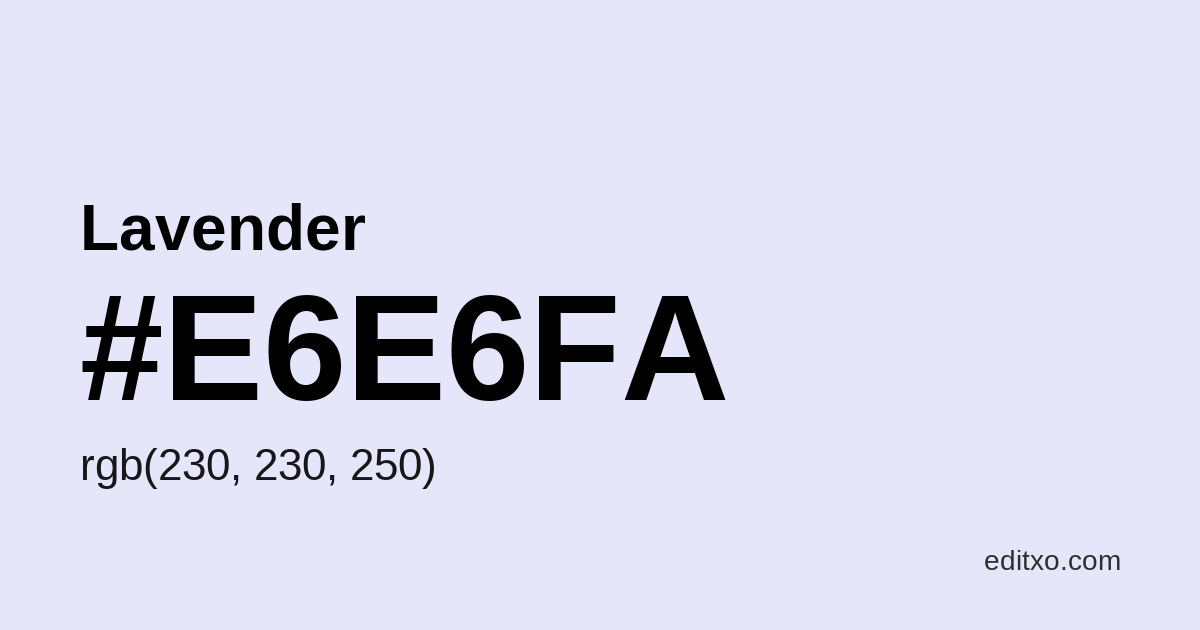
The lavender hex code is #E6E6FA, which is rgb(230, 230, 250). This is the lavender color code CSS uses, and it is much paler than most people expect; darker lavenders are listed below. Want a stronger light purple instead? Jump to the table of eight codes.
Reference
Lavender color code in every format
This table is your quick copy list. All values were computed from #E6E6FA by script, so you never convert by hand. The CMYK row is a basic conversion from RGB and not a print profile.
| Format | Value |
|---|---|
| HEX | #E6E6FA |
| RGB | rgb(230, 230, 250) |
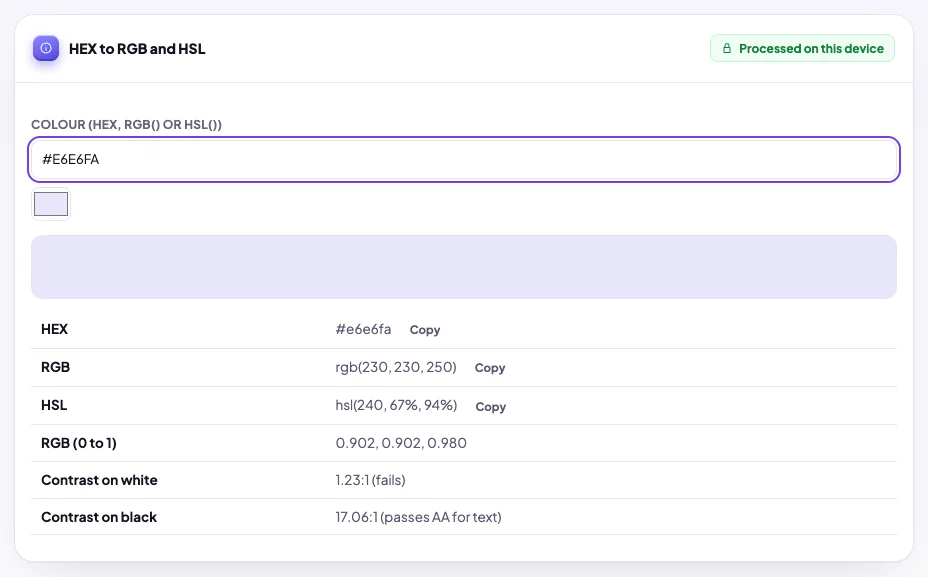
| HSL | hsl(240, 67%, 94%) |
| HSV (hue, saturation, value) | 240, 8%, 98% |
| CMYK (simple conversion) | 8%, 8%, 0%, 2% |
| CSS keyword | lavender |
| Contrast against white | 1.23:1 |
| Contrast against black | 17.06:1 |
In depth
Lavender RGB: rgb(230, 230, 250)
Lavender in RGB is red 230, green 230 and blue 250. Red and green match, and blue is the highest by 20 steps. So the colour leans blue, not red. That is why #E6E6FA reads as a cool, icy tint and not a warm pink-purple.
As fractions from 0 to 1, lavender is 0.902, 0.902, 0.980. Use that form in shader code and some graphics libraries.
Reference
Copy-ready CSS lines for lavender
Each line below gives the same colour in a browser.
| Style | CSS line |
|---|---|
| Hex | color: #E6E6FA; |
| Hex as a background | background-color: #E6E6FA; |
| RGB | color: rgb(230, 230, 250); |
| HSL | color: hsl(240, 67%, 94%); |
| Keyword | color: lavender; |
Checklist
Why #E6E6FA looks so pale
Lightness is 94%. That puts #E6E6FA a hair away from white, with a faint blue-violet cast. If you searched for lavender hoping for the purple of the flower, this code is probably too light.
It is still the only lavender with a formal standing. The W3C CSS Color Module Level 4 defines the named colour lavender as #E6E6FA, and we read that list on 17 November 2026. Outside CSS, paint charts and palette sites each choose their own lavender, and we found no common standard.
- Hue is 240, the same as pure blue.
- Saturation is 67%, but lightness is 94%, so the colour feels soft, not vivid.
- It works as a surface or background colour. It does not work as a text colour.
Reference
Lavender or light purple? Pick the right hex code
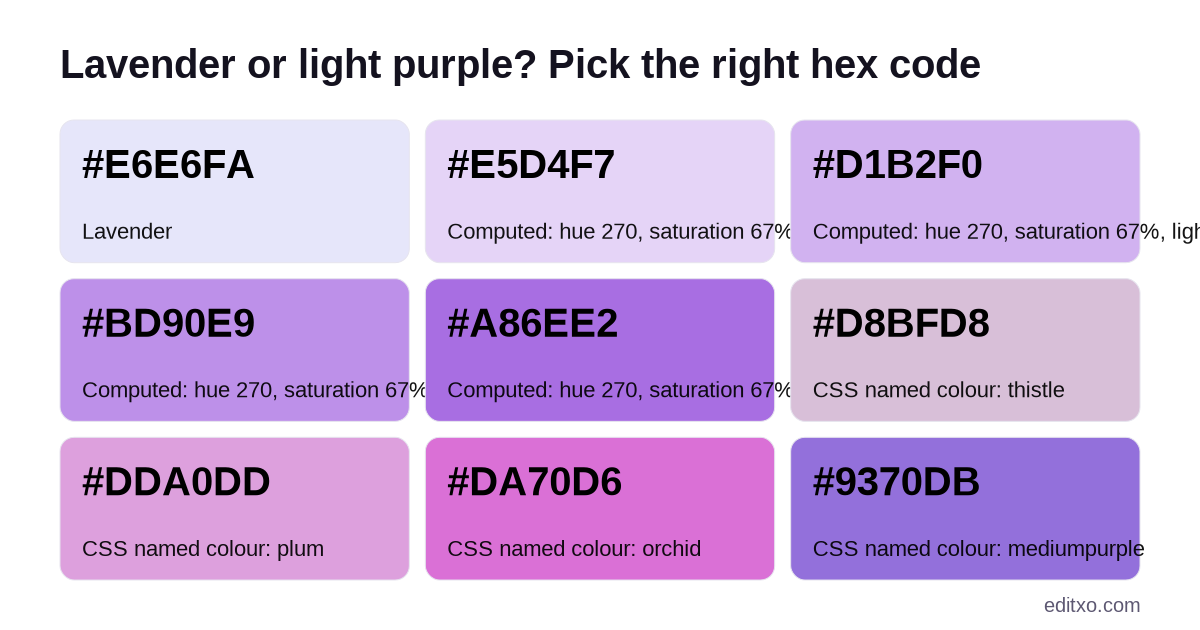
CSS has no colour called light purple, and we found no standard code for it. If you want a light purple hex code, you usually need something stronger than #E6E6FA. The first four codes below are a computed ladder at hue 270, which is a true purple. They keep saturation fixed at 67% and step the lightness down. The last four are real CSS purple names.
The HSL column is read back from the rounded hex, so it can differ by a point from the setting in the Method column. None of the ladder codes is an official colour name.
| Variant | Method | HEX | RGB | HSL |
|---|---|---|---|---|
| 1 | Computed: hue 270, saturation 67%, lightness 90% | #E5D4F7 | rgb(229, 212, 247) | hsl(269, 69%, 90%) |
| 2 | Computed: hue 270, saturation 67%, lightness 82% | #D1B2F0 | rgb(209, 178, 240) | hsl(270, 67%, 82%) |
| 3 | Computed: hue 270, saturation 67%, lightness 74% | #BD90E9 | rgb(189, 144, 233) | hsl(270, 67%, 74%) |
| 4 | Computed: hue 270, saturation 67%, lightness 66% | #A86EE2 | rgb(168, 110, 226) | hsl(270, 67%, 66%) |
| 5 | CSS named colour: thistle | #D8BFD8 | rgb(216, 191, 216) | hsl(300, 24%, 80%) |
| 6 | CSS named colour: plum | #DDA0DD | rgb(221, 160, 221) | hsl(300, 47%, 75%) |
| 7 | CSS named colour: orchid | #DA70D6 | rgb(218, 112, 214) | hsl(302, 59%, 65%) |
| 8 | CSS named colour: mediumpurple | #9370DB | rgb(147, 112, 219) | hsl(260, 60%, 65%) |
Reference
Can you put text on lavender? Contrast results
The WCAG 2.1 minimum is 4.5:1 for body text. Big text, icons and borders need 3:1. Pale colours are hard to judge by eye, so measure them.
White on #E6E6FA is only 1.23:1, so white text vanishes. Black on lavender is 17.06:1, which is very strong. Among the eight variants, two reach 3:1 with white: the lightness 66% ladder step and mediumpurple. None reaches 4.5:1.
| Colour | HEX | On white | White text result | On black | Black text result |
|---|---|---|---|---|---|
| Lavender (main) | #E6E6FA | 1.23:1 | Fails 3:1 | 17.06:1 | Passes 4.5:1 |
| Ladder, lightness 90% | #E5D4F7 | 1.39:1 | Fails 3:1 | 15.09:1 | Passes 4.5:1 |
| Ladder, lightness 82% | #D1B2F0 | 1.85:1 | Fails 3:1 | 11.34:1 | Passes 4.5:1 |
| Ladder, lightness 74% | #BD90E9 | 2.52:1 | Fails 3:1 | 8.33:1 | Passes 4.5:1 |
| Ladder, lightness 66% | #A86EE2 | 3.5:1 | Large text and UI parts only (3:1) | 5.99:1 | Passes 4.5:1 |
| thistle | #D8BFD8 | 1.7:1 | Fails 3:1 | 12.36:1 | Passes 4.5:1 |
| plum | #DDA0DD | 2.07:1 | Fails 3:1 | 10.15:1 | Passes 4.5:1 |
| orchid | #DA70D6 | 2.89:1 | Fails 3:1 | 7.27:1 | Passes 4.5:1 |
| mediumpurple | #9370DB | 3.76:1 | Large text and UI parts only (3:1) | 5.58:1 | Passes 4.5:1 |
Reference
Dark colours that work on a lavender background
Lavender needs a darker partner for text, links and buttons. Each code below keeps saturation at 67% and sets the lightness shown. The last column is its contrast on a #E6E6FA background.
- A blue-leaning partner at hue 240 matches the cool tint of lavender.
- A purple partner at hue 270 shifts the page toward violet.
| Partner | HEX | On lavender | On white | Result as text on lavender |
|---|---|---|---|---|
| Hue 240, lightness 60% | #5555DD | 4.58:1 | 5.63:1 | Passes 4.5:1 |
| Hue 240, lightness 40% | #2222AA | 9.09:1 | 11.19:1 | Passes 4.5:1 |
| Hue 240, lightness 20% | #111155 | 13.81:1 | 17.0:1 | Passes 4.5:1 |
| Hue 270, lightness 60% | #9955DD | 3.63:1 | 4.47:1 | Large text and UI parts only (3:1) |
| Hue 270, lightness 40% | #6622AA | 7.19:1 | 8.84:1 | Passes 4.5:1 |
| Hue 270, lightness 20% | #331155 | 12.62:1 | 15.53:1 | Passes 4.5:1 |
Reference
Palettes that pair with lavender
These four schemes turn the hue of #E6E6FA around the HSL wheel and keep saturation and lightness. Every partner is therefore a pastel. They suit soft layouts, and you still need a dark colour from the table above for text.
| Scheme | Hue rotation | Codes |
|---|---|---|
| Complementary | 180 degrees | #FAFAE6 |
| Analogous | +30 degrees, then -30 degrees | #F0E6FA, #E6F0FA |
| Triadic | +120 degrees, then +240 degrees | #FAE6E6, #E6FAE6 |
| Split-complementary | +150 degrees, then +210 degrees | #FAF0E6, #F0FAE6 |
Checklist
Where lavender fits
- Card backgrounds, selected rows and banners, where you want to set a block apart without a hard border.
- Wedding stationery and soft branding, with dark type on top.
- Wellness and sleep apps, where a quiet tone suits the topic. Test it with your own audience before you rely on that.
- Interior and fabric work. Screens show very pale colours differently, so match #E6E6FA to a physical swatch in the room.
Step by step
Try it now: sample lavender from a photo
Pale tints are hard to judge on screen. Measure them instead. Both tools below run on your device and upload nothing.
- 1
Start in the colour palette from image tool. Add a photo of the lavender, such as a flower, a scarf or a painted wall.
- 2
Click a pixel in the lightest, flattest area. Highlights and shadows give very different codes.
- 3
Copy the code and paste it into the HEX to RGB converter. It accepts hex, rgb() and hsl().
- 4
Compare the result with #E6E6FA. Red and green near 230 and blue near 250 mean a similar pale tint.
- 5
Read the contrast on white and black, and pick a dark text colour for any background this pale.
- Limit: a sampled tint carries the lighting of the photo, so it may not match the real object.
In depth
How this guide was made
The lavender code was read from the W3C CSS Color Module Level 4 list of named colours on 17 November 2026, along with the four CSS purples in the variants table. Everything else that is a number was computed from those codes by a Python script. That covers the formats, the ladder, the contrast ratios and the palettes.
The text was drafted with AI assistance and reviewed before publishing. Pale colours vary a lot between displays, so check on the screen your audience will use.
In pictures
See it
What is the lavender color code?
The lavender color code is #E6E6FA, which is rgb(230, 230, 250) and hsl(240, 67%, 94%). It is the value of the CSS named colour lavender. Other sources may list a deeper purple under the same name.
What is the hex code for lavender?
The lavender color hex is #E6E6FA. Short form: lavender hex #E6E6FA. If a design brief only says lavender, ask for the code, because many swatch sets use a stronger shade.
Which hex code is light purple?
CSS has no named light purple and we found no standard code. If #E6E6FA is too pale, try #D1B2F0 or #BD90E9 from the table above. Both are computed at hue 270. For a named option, plum is #DDA0DD and mediumpurple is #9370DB.
Why does lavender look so pale?
Lightness is 94%, so #E6E6FA is only a hint of colour above white. Many lavender swatches in paint and fashion are deeper than the CSS value.
What text colour works on a lavender background?
Black or a dark colour. Black on #E6E6FA has a contrast ratio of 17.06:1, well above the 4.5:1 minimum. White on lavender is only 1.23:1 and is not readable.
Is lavender a CSS color name?
Yes. Writing color: lavender in CSS gives #E6E6FA. A related name, lavenderblush, is a different, pinker tint. Use a hex code instead when you need a deeper purple that has no CSS name.
Do it yourself
Tools used in this guide
Check the numbers
Sources and further reading
Ready to try it?
Use the free tool or the full photo editor. Everything stays on your device.