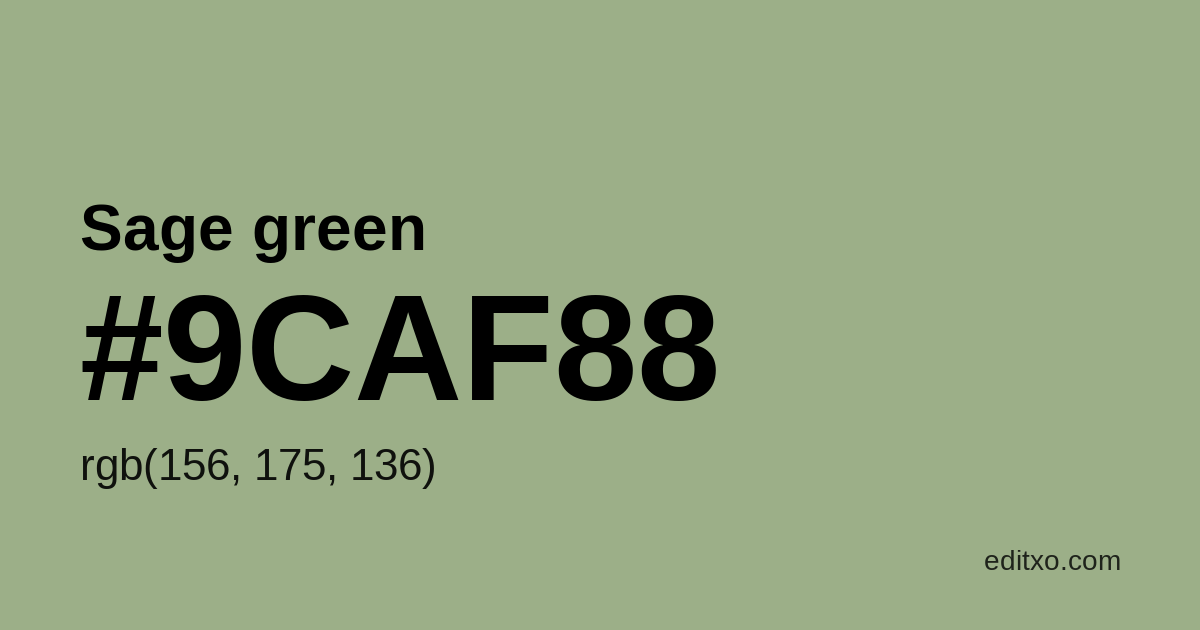
Sage green hex code: #9CAF88, with color code and palette
One common sage green hex code is #9CAF88, which is rgb(156, 175, 136). Sage green has no official code, so this sage green color code is a working value, with matching palettes below.
Reference
Sage green color code in every format
Pick the row that matches the field you are filling in. All values were computed by code from the single hex value #9CAF88, so none of them were typed from memory and they agree with each other.
| Format | Value |
|---|---|
| HEX | #9CAF88 |
| RGB | rgb(156, 175, 136) |
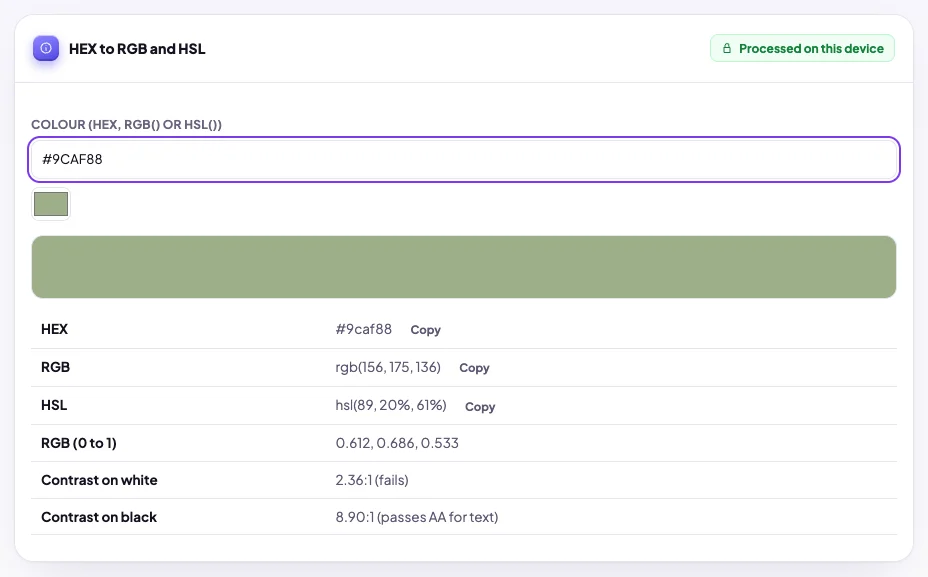
| HSL | hsl(89, 20%, 61%) |
| HSV | 89, 22%, 69% |
| CMYK | 11%, 0%, 22%, 31% (simple conversion) |
In depth
Sage green RGB: what the three numbers say
Sage green is rgb(156, 175, 136). Green is the largest number at 175, red is 156 and blue is the smallest at 136. That is why it reads as green.
All three numbers are close together. When the channels are this close the colour has low saturation (20 percent in HSL), so it looks soft and grey-green and not bright.
Checklist
Is there an official sage green code?
No. The W3C CSS Color Module lists the named colours that browsers understand, and sage is not among them, so you cannot write color: sage in a stylesheet. Paint makers, fabric brands and design apps each publish their own sage, and the codes differ.
The code on this page, #9CAF88, is one common sage value for a soft grey-green. We cannot show that it is the most used, so treat it as a sensible starting point rather than a standard.
The practical rule: if you are matching a brand, a paint colour or a printed sample, take the value from that source. If you just need a calm sage for a website, #9CAF88 is a sensible starting point that you can then adjust with the variants below.
- In HSL the hue is 89 degrees, saturation 20% and lightness 61%.
- In RGB the green channel (175) is the largest, red (156) is next and blue (136) is the smallest.
- The shade and tint rows below keep the hue near 89 and change only how much white or black is mixed in.
Reference
Which CSS colour is closest to sage green?
Sage is not a CSS name, but you can still ask which named colour sits nearest. We measured the straight-line distance in RGB, on the 0 to 255 scale, from #9CAF88 to all 141 CSS named colours (gray and grey spell the same, so only one spelling is counted).
- darkseagreen (#8FBC8F) is the nearest, about 20 steps away. Its hue is 120 degrees and its saturation 25%, against 89 degrees and 20% for sage.
- The next nearest, darkgray, is almost twice as far. Sage is closer to a muted green than to a plain grey.
- If you need a CSS name as a quick stand-in, darkseagreen is the nearest. It is not the same colour, so use #9CAF88 when you want sage.
| CSS name | HEX | Distance from #9CAF88 | White text | Black text |
|---|---|---|---|---|
| darkseagreen | #8FBC8F | 20 | 2.15:1 | 9.76:1 |
| darkgray | #A9A9A9 | 36 | 2.35:1 | 8.94:1 |
| darkkhaki | #BDB76B | 45 | 2.07:1 | 10.15:1 |
Reference
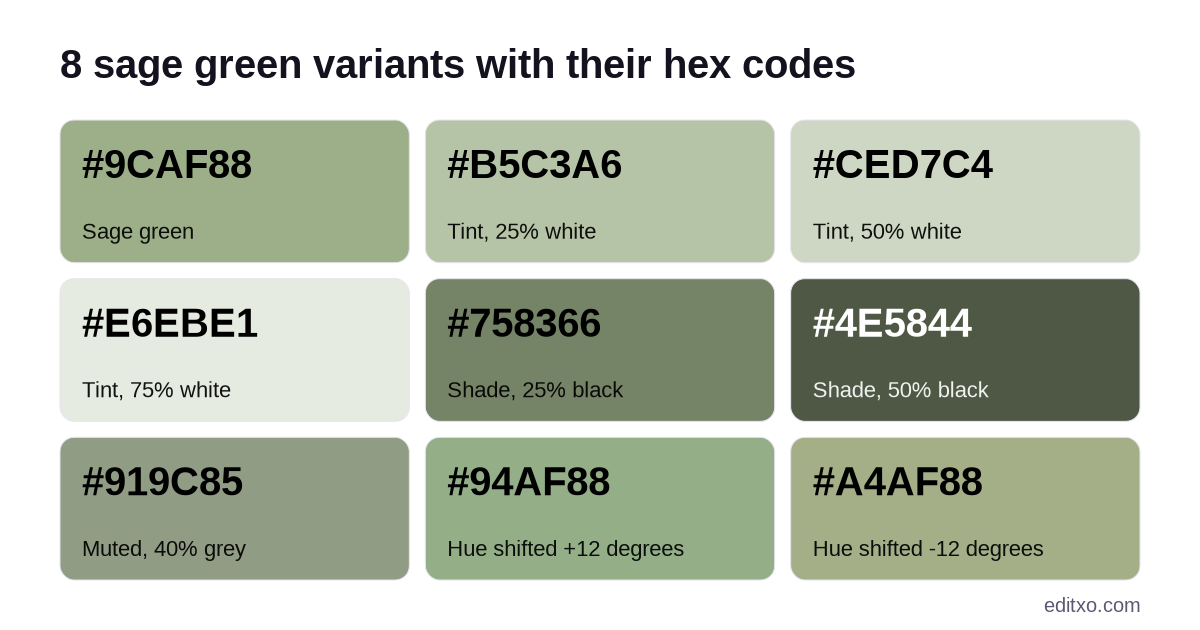
8 sage green variants with their hex codes
Every row below comes from one stated step applied to #9CAF88: white mixed in for the three tints, black mixed in for the two shades, 40 percent mid grey (#808080) mixed in for the muted row, and the hue turned 12 degrees for the last two. The +12 row lands at hue 102 (greener) and the -12 row at hue 77 (yellower), with saturation 20% and lightness 61% unchanged. No invented colour names are used.
| How it was computed | HEX | RGB | HSL |
|---|---|---|---|
| Tint, 25% white | #B5C3A6 | rgb(181, 195, 166) | hsl(89, 19%, 71%) |
| Tint, 50% white | #CED7C4 | rgb(206, 215, 196) | hsl(88, 19%, 81%) |
| Tint, 75% white | #E6EBE1 | rgb(230, 235, 225) | hsl(90, 20%, 90%) |
| Shade, 25% black | #758366 | rgb(117, 131, 102) | hsl(89, 12%, 46%) |
| Shade, 50% black | #4E5844 | rgb(78, 88, 68) | hsl(90, 13%, 31%) |
| Muted, 40% grey | #919C85 | rgb(145, 156, 133) | hsl(89, 10%, 57%) |
| Hue shifted +12 degrees | #94AF88 | rgb(148, 175, 136) | hsl(102, 20%, 61%) |
| Hue shifted -12 degrees | #A4AF88 | rgb(164, 175, 136) | hsl(77, 20%, 61%) |
Reference
Sage green contrast: black text works, white text does not
WCAG scores a pair of colours by the ratio of their relative luminance, from 1:1 (no difference) to 21:1 (black on white). At level AA the target is 4.5:1 for normal text, and 3:1 for large text and for the edges of controls such as buttons, icons and form borders.
Plain #9CAF88 gives 2.36:1 with white lettering, below even the 3:1 line, and 8.90:1 with black lettering, a clear pass. Read the table row by row: each row is a background colour, and the following columns score white and black lettering placed on it.
- Use dark text on #9CAF88 and on all three tints (#B5C3A6, #CED7C4, #E6EBE1); every one of them clears 4.5:1 with black.
- If you need white text on a sage background, move down to the 50% black shade #4E5844 (7.49:1). The 25% shade #758366 reaches 4.04:1, which is only enough for large text and UI parts.
- Do not use #9CAF88 as the only signal for a button border or icon on a white page: 2.36:1 is below the 3:1 line, so add a darker outline.
| Colour as background | HEX | White text ratio | White text result | Black text ratio | Black text result |
|---|---|---|---|---|---|
| Main colour | #9CAF88 | 2.36:1 | Fails 3:1 | 8.90:1 | Passes 4.5:1 |
| Tint, 25% white | #B5C3A6 | 1.85:1 | Fails 3:1 | 11.32:1 | Passes 4.5:1 |
| Tint, 50% white | #CED7C4 | 1.48:1 | Fails 3:1 | 14.14:1 | Passes 4.5:1 |
| Tint, 75% white | #E6EBE1 | 1.21:1 | Fails 3:1 | 17.34:1 | Passes 4.5:1 |
| Shade, 25% black | #758366 | 4.04:1 | Large text and UI parts only (3:1) | 5.19:1 | Passes 4.5:1 |
| Shade, 50% black | #4E5844 | 7.49:1 | Passes 4.5:1 | 2.80:1 | Fails 3:1 |
| Muted, 40% grey | #919C85 | 2.88:1 | Fails 3:1 | 7.30:1 | Passes 4.5:1 |
| Hue shifted +12 degrees | #94AF88 | 2.40:1 | Fails 3:1 | 8.75:1 | Passes 4.5:1 |
| Hue shifted -12 degrees | #A4AF88 | 2.32:1 | Fails 3:1 | 9.07:1 | Passes 4.5:1 |
Reference
Sage green color palette: four matching palettes
These partners come from turning the hue of #9CAF88 around the HSL wheel while saturation stays at 20% and lightness at 61%. The complementary code #9B88AF sits at hue 269, in the purple range. The analogous pair sits at hue 59 (#AFAE88) and hue 119 (#89AF88). Because every partner has the same lightness, check text contrast on each one before using it, and darken one partner if you need an accent that carries white text.
| Scheme | Hue rotation from the main colour | Codes |
|---|---|---|
| Complementary | 180 degrees | #9B88AF |
| Analogous | -30 and +30 degrees | #AFAE88, #89AF88 |
| Triadic | +120 and +240 degrees | #889CAF, #AF889C |
| Split-complementary | +150 and +210 degrees | #8889AF, #AE88AF |
Checklist
Copy-ready CSS for the sage green palette
Paste these custom properties into a stylesheet. Each comment says how the colour was computed from #9CAF88.
- --sage: #9CAF88; /* main colour */
- --sage-complement: #9B88AF; /* hue +180 */
- --sage-analogous-1: #89AF88; /* hue +30 */
- --sage-analogous-2: #AFAE88; /* hue -30 */
- --sage-triadic-1: #889CAF; /* hue +120 */
- --sage-triadic-2: #AF889C; /* hue +240 */
In depth
Ways to use sage green
Sage can work as a background for cards, banners or article sections with dark text on top: black lettering clears 4.5:1 on #9CAF88 and on all three tints. If you want white lettering on a sage-toned button, the 50% black shade #4E5844 passes at 7.49:1.
The palette table gives starting partners, for example the complementary #9B88AF as an accent. We make no claim about which industries use sage or how often.
If the sage is going on paper, remember the CMYK row is only a rough conversion. Ask your printer for a proof before you order a full run. Matching a wall, a fabric or a printed sample? Get the code from whoever made it, then compare it with the variants on this page.
In depth
Try it now: convert sage green and pull it from a photo
To check a sage value you already have, paste it into the hex-to-rgb tool. Try #9CAF88: you can compare the result with the table above, see its contrast against white and against black, and use the colour picker to nudge it. It accepts 3 and 6 digit hex, rgb() and hsl() input, and nothing is uploaded.
To find sage tones in your own photo, load it into the color-palette-from-image tool, choose between 2 and 12 colours, and read the swatches its median-cut method returns. Click a pixel for an exact value, then copy the set as CSS variables. It runs on your device. A swatch near #758366 or #919C85 is a darker or greyer sage than #9CAF88.
Limits: a photo of leaves contains many greens that are not sage, and the tool reports pixel colours, not paint names. What you see also depends on your display, so print results need a proof.
In depth
How this guide was made
Sage green has no entry in the W3C list of CSS named colours (checked 14 November 2026), so there is no official code. This page picks one working value and says so. The formats, variants, palettes, distances to CSS names and contrast figures are all calculated from that value with a script. The CSS name list used for the distance table is the CSS Color Module list; darkseagreen was checked on the W3C page on 17 November 2026.
AI assistance was used to draft the text. Before publishing, an automated check recalculated the numbers. Paint brands each sell their own sage, so match a physical sample if the colour is for a wall or fabric.
In pictures
See it
What is the hex code for sage green?
One common sage green hex is #9CAF88, equal to rgb(156, 175, 136). Sage green has no official code, and different colour references list different values for it, so use the code your brand or print maker supplies if you have one.
What is the sage green color code?
On this page the sage green color code is #9CAF88. It is a working value, not a standard, because sage is not a CSS named colour. You need to use a hex, rgb() or hsl() value.
What is the RGB value of sage green?
The sage green RGB code for #9CAF88 is rgb(156, 175, 136). In HSL that is hsl(89, 20%, 61%), and in HSV it is 89, 22%, 69%.
What is a good sage green color palette?
Start with the four palettes above. For a calm look, try the analogous pair #AFAE88 and #89AF88. For contrast, try the complementary #9B88AF as a small accent. Every partner has the same lightness as sage, so check text contrast before you use one.
Does white text work on sage green?
Not on #9CAF88. White text on it has a contrast ratio of 2.36:1, below the 3:1 minimum for large text. Black text reaches 8.90:1 and passes comfortably.
What is the CMYK value of sage green?
A simple conversion of #9CAF88 gives 11% cyan, 0% magenta, 22% yellow and 31% black. A printer using an ICC colour profile will produce different numbers, so ask your print shop before you commit.
Do it yourself
Tools used in this guide
Check the numbers
Sources and further reading
Ready to try it?
Use the free tool or the full photo editor. Everything stays on your device.